DIY
How to load a moving truck: heavy first, in tiers, tied every row
Loading a moving truck means the heaviest items go in first, low and toward the cab, then each row is built in tiers and tied before the next one starts. Haulest is not a truck rental company and earns nothing from any brand, so the rules below come from what U-Haul, Penske and Budget publish on their own pages.

Anthony BaleMoving industry professional, author and writerReviewed 29 September 2026
Ramp and max load as each brand prints them, read 28 Sep 2026. Specs vary by model year and location.
| Truck | Ramp | Max load |
|---|---|---|
| U-Haul 9' cargo van | No ramp | 4,030 lb |
| U-Haul 10' truck | No ramp | 2,850 lb |
| U-Haul 15' truck | EZ-Load ramp, 2'2" wide | 6,385 lb |
| U-Haul 20' truck | Ramp, 2'2" wide | 5,700 lb |
| U-Haul 26' truck | EZ-Load ramp, 2'7" wide | 12,859 lb |
| Penske cargo van | No ramp | 3,500 lb |
| Penske 12' truck | No ramp | 3,100 lb |
| Penske 16' truck | 1,000 lb loading ramp | 4,300 lb |
| Penske 22' truck | 1,000 lb loading ramp | 10,000 lb |
| Penske 26' truck | 1,000 lb loading ramp | 10,000 lb |
| Budget cargo van | No ramp | 3,550 lb |
| Budget 12' truck | No ramp | 3,610 lb |
| Budget 16' truck | Ramp, 1,000 lb | 4,460 lb |
| Budget 26' truck | Ramp, 1,000 lb | 9,180 lb |
Before the first box
an extra 100 pounds can cut fuel mileage by 1 to 2 percent
Clear what you will not move. Penske says get rid of what you do not need, since an extra 100 pounds can cut fuel mileage by 1 to 2 percent. Match the load with the inventory calculator and confirm a size on truck sizes before the first box goes in. No brand's 10 to 12 ft truck or cargo van has a ramp.
Know the ramp and the doorpost. Penske 16 ft and up and Budget 16 and 26 ft trucks have a ramp rated 1,000 lb, and U-Haul 15, 20 and 26 ft trucks have a ramp. U-Haul prints a maximum gross weight label on the driver's doorpost, and you should read it before you load. If the destination has stairs, Penske suggests unloading the heavy items first, before you get tired.
Heavy, low and forward
load the heaviest items first, in front and on the floor
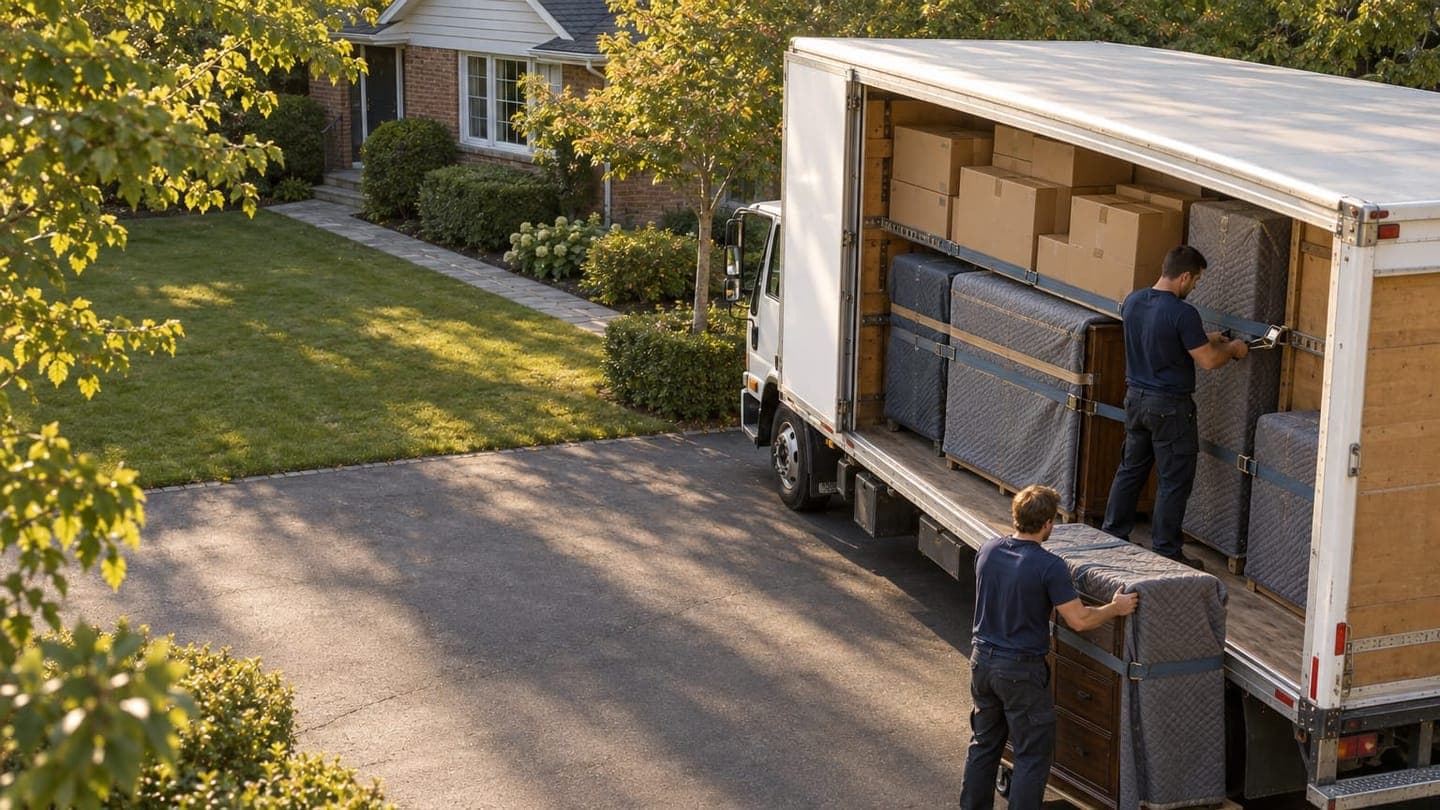
Put the heaviest items on first. U-Haul says load the heaviest items first, in front and on the floor, and the lightest last, on top and to the rear. Refrigerators, washers, dryers and heavy furniture go closest to the cab, where you can tie them to the front and side walls. Keep the weight balanced side to side so the truck stays stable.
Lift with your legs, then place it low. Penske says bend your knees and lift with your legs when the heavy pieces go on. Even loading improves fuel mileage and stability, so keep that weight forward and on the floor. For a partial load, U-Haul says tie it as close to the front as possible, which also helps when you drive the truck.
Build it in tiers
Stack boxes by weight, not size.
Stack a base, then a lighter layer. U-Haul describes tiers as a base of furniture and large items, heavier boxes at the bottom, lighter on top, then the next tier right behind with the same pattern. Stack boxes by weight, not size. Avoid leaning items; if something must lean, lean it toward the previous row.
Save the high space for fragile goods. In trucks 15 ft and longer, U-Haul says fragile items go first into Mom's Attic, the space over the cab. Pack those pieces with the fragile items guide so glass and frames are ready before they go up there. The attic is the spot that is both high and forward, which is a rare moving win.
Tie every row
A row that can slide will shove the tier behind it when you brake.
Tie the row before you start the next. U-Haul says to load in tiers, with tie-downs between each row. Refrigerators, washers, dryers and heavy furniture should be tied to the front and side walls once they sit closest to the cab. A row that can slide will shove the tier behind it when you brake.
A partial load still gets tied at the front. U-Haul says if the truck is only partly full, tie that load as close to the front as possible. Trailers follow a different split: about 60 percent of the weight goes in the front half, because a trailer loaded heavy at the rear can sway. Check your truck size so the cargo area you booked can hold those front rows.
The weight limit
Every U-Haul truck has a maximum gross weight label on the driver's doorpost
Read the label on the driver's doorpost. Every U-Haul truck has a maximum gross weight label on the driver's doorpost, and you should never exceed it. Printed examples differ by brand and length: a U-Haul 15 ft lists 6,385 lb, a Penske 16 ft lists 4,300 lb, and a Budget 16 ft lists 4,460 lb. Those figures are examples from each brand's pages, not a ranking.
Stay under the printed maximum. Even loading improves fuel mileage and stability, and an extra 100 pounds can cut fuel mileage by 1 to 2 percent. If the ramp is in use, remember Penske and Budget rate that ramp at 1,000 lb on the trucks that have it. If the load is near the printed maximum, leave the rest for a second vehicle.
Before you hire
Four checks before a deposit
Written estimate after a look
Interstate movers must give the booklet and a written estimate after a survey or a full description. A $499 ad is not an estimate.
FMCSA Protect Your MoveLegal name matches SAFER
USDOT on the paper, the truck doors, and the census. A different name is the walk.
USDOT / Companies House lookupWalk from cash and blank paper
FTC: unregistered interstate, huge deposit, cash only, or a blank contract. Photograph and leave.
FTC: hiring a mover110% on a COD non-binding job
Pay up to 110% plus agreed extras and they must hand over the load. Not a cap on extras you signed.
US interstate rules
Reviewed 29 September 2026 by Anthony Bale. Numbers on this page carry their own dates.
Ask out loud
Questions people ask
- Where do the heaviest items go in a moving truck?
- U-Haul says load the heaviest items first, in front and on the floor, with the lightest last, on top and to the rear. Refrigerators, washers, dryers and heavy furniture go closest to the cab so you can tie them to the front and side walls.
- How do you build the load in tiers?
- Start with a base of furniture and large items, put heavier boxes at the bottom and lighter boxes on top, then repeat that pattern in the next tier right behind. U-Haul says to put tie-downs between each row and to stack boxes by weight, not size.
- Should a partial load be tied down?
- Yes. U-Haul says a partial load should be tied as close to the front as possible. On a trailer, about 60 percent of the weight goes in the front half, because a trailer loaded heavy at the rear can sway.
- Which trucks have a ramp?
- Penske 16 ft and up and Budget 16 and 26 ft trucks have a ramp rated 1,000 lb. U-Haul 15, 20 and 26 ft trucks have a ramp. No brand's 10 to 12 ft truck or cargo van has a ramp.
- What weight limit should you follow?
- Every U-Haul truck has a maximum gross weight label on the driver's doorpost, and you should never exceed it. Published examples include a U-Haul 15 ft at 6,385 lb, a Penske 16 ft at 4,300 lb, and a Budget 16 ft at 4,460 lb. Even loading improves fuel mileage and stability.
Next
Keep going

About Anthony Bale
A moving industry professional, author and writer. Anthony has been at different positions in the industry for the last 10 years, gaining significant knowledge on the relocation process. He himself has moved 6 times already, which helped him explore the other side of the moving process.
At Haulest he writes the US cost, hiring, and rights pages, reading the licensed review file every week so the numbers on the page are the numbers people reported.
Call for a free quote
From, then To. Date and home size after that. A person on the phone is faster if you already know the dates.
+1 (866) 961-9682Free quote, a person answersHaulest is not a carrier. We connect you to movers.
Haulest is a research desk and quote line. We are not a carrier.